
 Temperature and humidity might seem like minor comfort issues, but in operating rooms (ORs), they’re critical to patient safety and infection control. Getting these conditions right is non-negotiable—but it’s not always simple. HVAC systems for surgical suites must walk a fine line between regulatory compliance, system capability, energy efficiency, and the preferences of the surgical team.
Here’s what building owners, planners, and facility managers need to know about managing OR conditions and expectations.
Regulations and Reality: ASHRAE 170 Is the Baseline
The American Society of Heating, Refrigerating and Air-Conditioning Engineers (ASHRAE) sets the benchmark for OR HVAC design through ASHRAE Standard 170. For operating rooms, it defines a design temperature range of 68–75°F and a relative humidity (RH) range of 20–60% ASHRAE 170-2021.
But here’s the rub: surgeons often request cooler rooms—as low as 64°F—to stay comfortable under surgical lights and gowns. Most OR HVAC systems can meet that temperature. What they often can’t do at the same time is keep the humidity below 60%.
Why Humidity Spikes When You Lower the Temperature
This isn’t a system failure. It’s physics.
Relative humidity increases as air temperature decreases, assuming moisture content stays the same. For example, air at 68°F and 60% RH, when cooled to 64°F, will jump to around 68% RH, which is outside the allowable limit.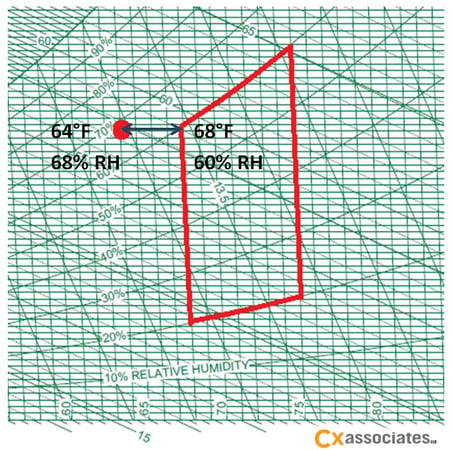
Figure 1: Psychrometric chart of air temperature (horizontal axis) and relative humidity [Copyright: ASHRAE 1992] with outline of ASHRAE Standard-170 design range for ORs
This confusion often sparks complaints from surgical teams and can lead to unnecessary system adjustments or redesign efforts. The truth is, ASHRAE 170’s humidity requirement applies only within the specified temperature range. If you're operating below 68°F, you're operating outside the standard.
A Team Problem, Not Just a Tech Problem
This disconnect highlights a recurring issue in healthcare facility management: expectations don’t always align with standards or equipment capabilities.
Facility managers should proactively educate OR users about the interplay between temperature and humidity, especially during humid seasons when systems are already working hard to manage moisture in outdoor air. At peak humidity, supply air is often around 55°F with 95% RH before it even enters the space.
Once inside, the air picks up heat, which lowers RH naturally as it moves across the psychrometric chart (a graphical representation of air properties used in HVAC design). But if the space temperature target is low, that same process doesn’t go far enough.
Engineering Options to Meet Low-Temp Preferences
To maintain RH below 60% at 64°F or lower, you’ll need more aggressive dehumidification strategies:
1. Use 45°F Chilled Water Coils in the Air Handler
Cooling the supply air further helps remove more moisture. But be warned, this approach:
-
-
- Requires more reheat energy downstream.
- Reduces hours when the system can use energy-efficient “free cooling” (economizers).
- Can increase annual energy costs significantly.
-
2. Add Supplemental DX Cooling in the OR Zone
A direct expansion (DX) coil adds localized cooling and moisture removal. It's a more targeted, energy-efficient solution, but:
-
-
- Controllability can be tricky without advanced compressors that modulate precisely.
- May require more frequent maintenance and careful integration with your BMS (building management system).
-
Best Practices: Design + Communication
Ultimately, this isn’t just an HVAC problem—it’s a collaboration challenge.
- Designers: Confirm your HVAC systems can maintain 64°F and <60% RH if it’s a client request, but educate on energy tradeoffs.
- Facility Managers: Use data and psychrometric visuals to inform OR users why certain comfort levels have unintended consequences.
- Healthcare Planners and Owners: Budget for flexible HVAC systems and enhanced control strategies when occupant preferences are non-negotiable.
Conclusion: Aligning People, Performance, and Policy
We all want OR environments that are safe, comfortable, and compliant. The key is finding the balance between user expectations and engineering realities—and communicating openly when those don’t align. At Cx Associates, we’ve been solving these HVAC challenges in healthcare environments for over two decades. We’re ready to help you design and operate systems that perform reliably and efficiently, even under pressure.
Resources
Editor's Note: This post was originally published in December 2014 and has been updated for accuracy and comprehensiveness.