
Energy Management Information Systems (EMIS) continuously monitor equipment/system performance, establish normalized baselines for how equipment should operate, track whether corrective actions persist over time, and detect when something begins to drift. Think of it as a fitness tracker for your building - one that learns what "normal" looks like and alerts operators when something changes.
Over the past month, our team at Cx Associates has been trialing a new generation of edge gateway hardware designed to securely collect data from building automation systems and stream it to our analytics platform. Navigating IT departments, establishing secure network connections, and solving data logistics challenges is rarely straightforward, which naturally raises the question: Why bother?
The answer lies in what granular data enables. In practice, buildings rarely fail dramatically. More often, they quietly drift away from optimal performance without anyone noticing.
Why Energy or Carbon Savings Often Don't Last
When an efficiency project wraps up, the results are usually clear: new equipment installed, control strategies improved, savings calculated. In most cases, the project performs as intended (at least initially).
But buildings aren't static. Staff turnover, schedules change, sensors drift out of calibration, equipment degrades, and temporary control overrides stay in place long after they're needed. These changes accumulate unnoticed until the building has drifted far from the conditions that originally produced those savings. This is what we call a persistence problem: the physical improvements may remain in place, but the energy or carbon savings they were designed to deliver do not persist without active stewardship. Research on commissioning programs suggests roughly 20–25% of energy savings can erode over several years without ongoing monitoring. The problem isn't that efficiency measures were ineffective, it's that complex buildings require continuous attention to maintain optimal performance and ensure performance persists over time.
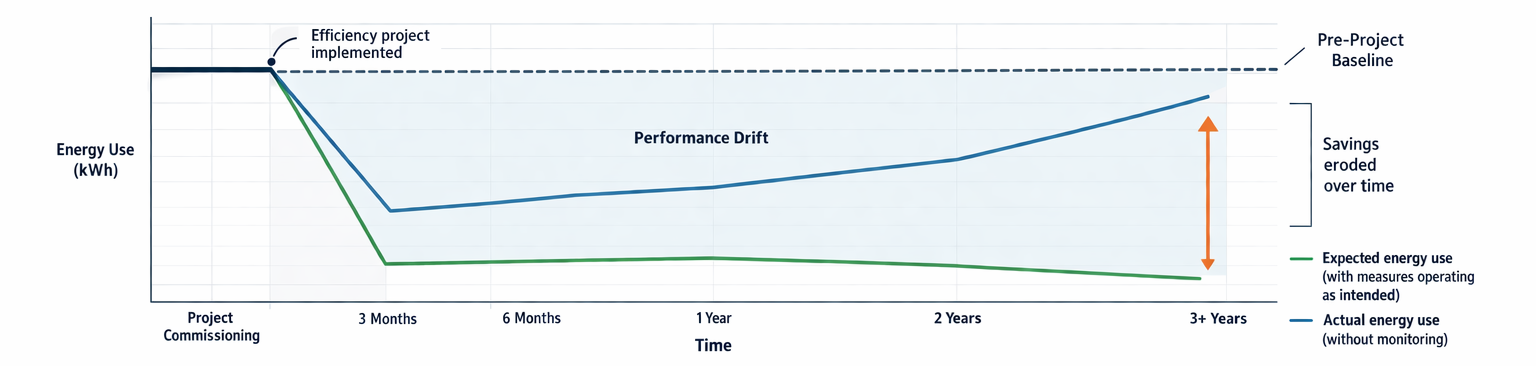
Graph Depicting performance Drift generated using AI. All other images and text in this blog post are Human Intelligence generated.
Beyond Dashboards: Engineering-Grade Analysis
Our EMIS approach builds on standard analytics dashboards with engineering-grade analysis grounded in measured energy performance. Drawing on our deep experience in measurement and verification (M&V) including Forward Capacity Market (FCM) savings verification, we use BAS data and temporary power metering (where needed) to develop equipment-level energy models that correlate control signals with actual power consumption. These calibrated baselines, normalized for weather and operating conditions, allow engineers to detect meaningful deviations from expected performance.
The result: the system doesn't just flag that energy consumption has increased. It identifies which system is responsible, which piece of equipment is behaving differently, and what operational change likely caused it.
Persistence Checks and Fault Detection
One of the most important and overlooked functions of EMIS is verifying that energy or carbon savings persist after they are achieved. Many energy conservation measures - VFDs, economizers, demand-controlled ventilation - deliver savings only when controls are working as intended. A single overridden sequence can quietly erase the benefit. Persistence checks address this by comparing real-time data against baseline expectations, allowing our engineers to find the root cause of deviations often within days rather than months.
Automated Fault Detection and Diagnostics (FDD) extends this further, continuously scanning for patterns like equipment short cycling, simultaneous heating and cooling, or VFDs operating out of expected range. This is where a dedicated FDD platform differs meaningfully from the native alarming built into most building automation systems. A BAS is designed to control equipment, its alarm capabilities are broad by default, and without careful tuning, a facility can easily find itself buried in hundreds of alerts, many of them low-priority or redundant. Over time, this leads to alarm fatigue, where operators begin ignoring notifications altogether, and real issues slip through unnoticed.
A dedicated EMIS takes a different approach. Before automated monitoring begins, our engineers work directly with facility managers to understand their priorities, operational constraints, and what the intended normal looks like for their specific building. Fault rules and alert thresholds are configured around those requirements, not generic defaults. The result is a much smaller set of meaningful, actionable alarms rather than a flood of noise. And when a fault is flagged, it isn't simply passed along as a raw alert. Engineers evaluate it in the context of how the building operates, filter out false positives, and recommend specific corrective actions. That combination of thoughtful setup and ongoing engineering interpretation is what transforms FDD from a notification system into a genuine diagnostic tool.
A Real-World Example: The Compressor That Wasn't Saving Energy
During M&V work at a local business, a newly installed high-efficiency air compressor was expected to reduce electricity consumption significantly. But operational data told a different story.
Figure 1 shows compressor power usage over a one-month window at the beginning of the verification study. Rather than running steadily, the new compressor (blue) cycles erratically, spiking and dropping repeatedly throughout the day. Meanwhile, the old, less efficient compressor (orange) runs almost continuously in the background. Investigation revealed the cause: a compressed air leak was causing intermittent pressure drops, preventing the new compressor from maintaining system pressure on its own and forcing the backup unit to pick up the slack. The combined load of both compressors running simultaneously effectively negated the expected operating cost savings. Figure 2 shows the same equipment’s power usage after the leak was repaired. The new compressor now runs at a consistent, low load with only occasional spikes during peak demand. The old compressor is largely idle. The difference in operational pattern and energy consumption is immediately visible.
The issue had persisted for over a year before it was identified. With EMIS in place, persistence monitoring would have flagged the abnormal cycling and unexpected load sharing within days, turning what became a costly, prolonged inefficiency into a simple repair.
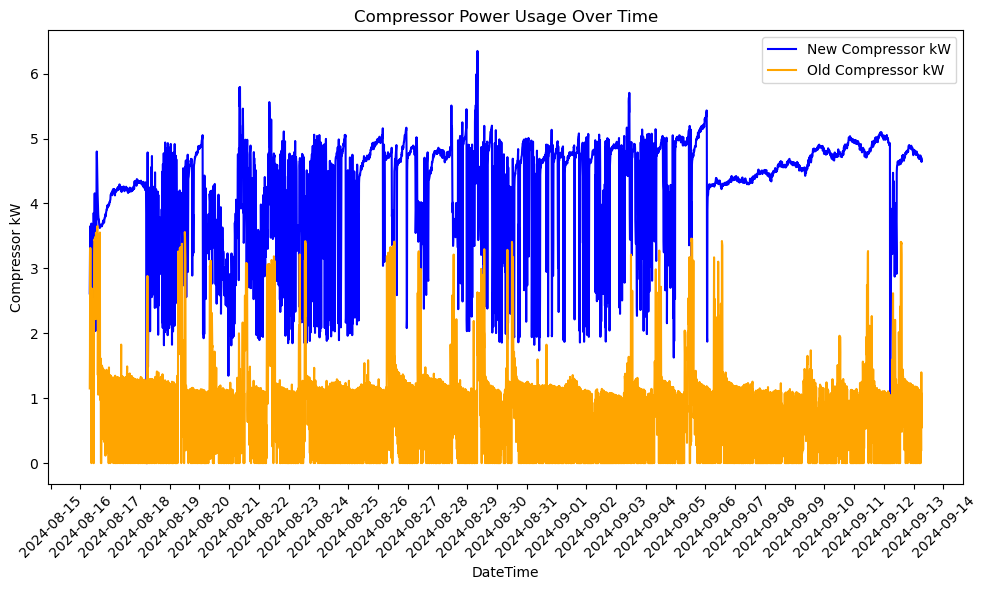
Figure 1: Compressor power usage during the fault period (August–September 2024). The new compressor cycles erratically while the old compressor runs nearly continuously to compensate for pressure loss.
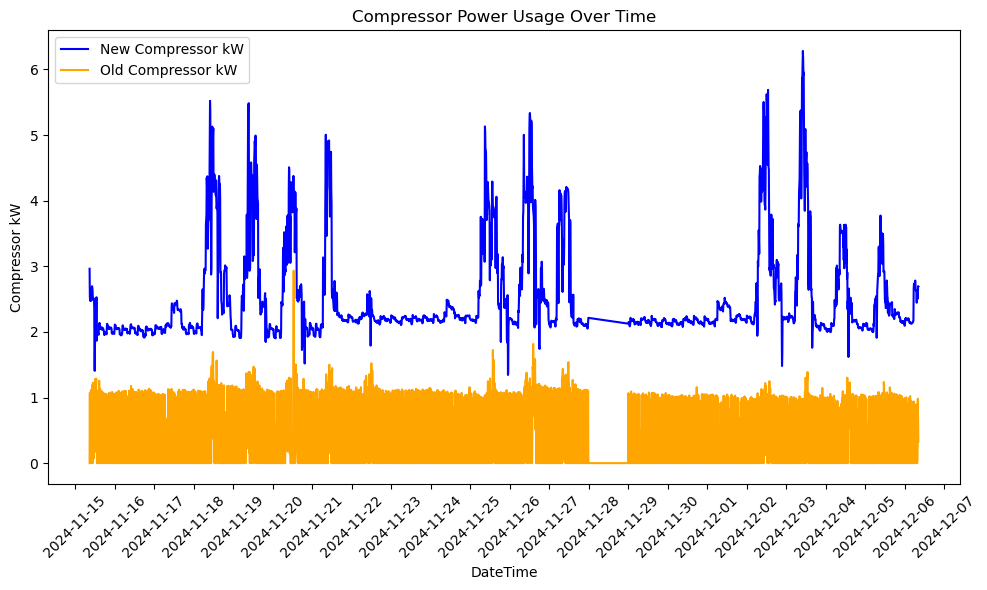
Figure 2: Compressor power usage following repair (November–December 2024). The new compressor operates steadily and the old compressor is rarely needed.
Insight at Every Level
Cx Associates' EMIS framework models energy use at the equipment level and aggregates upward to systems, building, and portfolio. This lets executives track ROI and energy/carbon metrics, facility managers monitor equipment runtime and maintenance indicators, and operators receive detailed diagnostics and real-time alerts leading to a shared understanding of building performance across the entire organization.
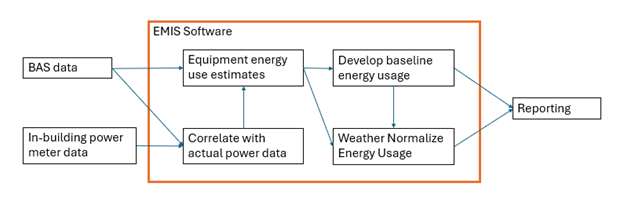 High-level EMIS framework. Customizations Such As optional in-building power meters, normalizing to Variables Other than weather, and options/outcomes beyond reporting are possible.
Supporting Decarbonization and Long-Term Performance
Electrification strategies, heat pumps, energy recovery systems, advanced ventilation controls, rely heavily on system coordination and control logic. If these systems aren't operating as intended, energy use and costs can rise significantly. EMIS provides the visibility needed to ensure these investments perform as designed and continue to do so over time, extending the value of decarbonization projects.
Conclusion
Buildings are long-term investments, and so are the efficiency measures installed in them. But without visibility into how those systems are actually operating, savings achieved today can quietly erode tomorrow. EMIS closes that gap, not by replacing the expertise of engineers and facility managers, but by giving them the data and diagnostics they need to stay ahead of problems rather than react to them. Industry studies consistently show that analytics-based monitoring can deliver 5–15% energy or carbon savings through operational improvements alone. More importantly, it protects the investments already made and ensures that those savings persist year after year, not just in the months after a project closes. Whether the goal is reducing energy costs, meeting decarbonization targets, or simply keeping a building running the way it was designed to, EMIS ensures that good work doesn't go to waste.